 A major snow storm hit the northeastern United States on St. Valentine's Day. A second storm is now upon us. Not as severe, but skiers and snowboarders are very happy to see their season extended. Wasalam!
Friday, March 02, 2007
Snow and More Snow
A major snow storm hit the northeastern United States on St. Valentine's Day. A second storm is now upon us. Not as severe, but skiers and snowboarders are very happy to see their season extended. Wasalam!


Wild Tukeys of North America
 I thought I would share with my African friends a picture of wild turkeys. I live in a rural area of Vermont and turkeys are frequent visitors to our house because we feed birds. We spread cracked corn around for the turkeys. See the Wikipedia entry in order to know more about the wild turkey. They are wary birds and often fly in because the snow is too deep for them to walk in. Wasalam!
Monday, January 29, 2007
Monduli Teachers College releases website
TanEdu, the blog site for Tanzania Education and Information Services Trust announced recently that the Monduli Teachers College in Arusha released its website. The College motto is "Education for Liberation". The institution runs an elementary and secondary school. It has been in existence since 1971 and enrolled women for the first time in 1979.
Wednesday, January 17, 2007
More Environmental Assaults on the Serengeti
Can you image an airport in the Serengeti? An opinion article in The East African is reporting that Grumeti Reserves Ltd. is supporting such a project to bring more tourists to the sacred Serengeti. This concept does not sit well with me. A much more appropriate approach would be to renovate the existing Kilimanjaro International Airport (KIA) as well as existing road links. Keep development near the Serengeti “at bay”. Once that line is crossed the pressure and need to develop expands exponentially. Think of the support apparatus needed to sustain an airport -- hotels, restaurants, transportations depots for high-roller tourists. It becomes an expanding organism that has no boundaries. Improve KIA and its infrastructure and keep the Serengeti pristine.
Friday, December 15, 2006
Road links between Tanzania and Kenya to improve
 The African Development Bank (ADF) approves loan to rehabilitate road links between Tanzania and Kenya. The overall goals of the project are to "support regional integration, cross border trade, tourism, socio-economic development of the area and contribute to the reduction of poverty."
Wednesday, November 01, 2006
Elephants can recognize self in mirror
 National Geographic News reported recently that elephants can recognize themselves in mirrors. Elephants join humans, great apes and dolphins as having this self-awareness ability reports the news item.
Friday, October 06, 2006
Latest News About Tanzania
 In this post, you will find continuously updated links to news stories about Tanzania. I am providing links to the Arusha Times, a weekly from Tanzania's largest city in the northeast quadrant and a news feed from allAfrica.com. Enjoy and happy planning for your trip to Tanzania, the land of Ndugu.
Current news, however, are not adequate to capture the rich history, culture and nature of Africa. To fill that gap, Carol and I are compiling a reading list of books about Africa. The selections present the views of the past, present and future of a continent that has captured our hearts. In addition, I discovered two online guide to Tanzania: Explorer's Guide to Tanzania on the BBC site and Lonely Planet's online guide to Tanzania. Bahati njema!
Of course you can also consult the log of our December 2004 Serengeti safari and associated photographic collections: Arusha and environs, Kambi ya Tembo, Tarangire, Olgira le Korongoro, Olduvai and Shifting Sands, and Elwai Esirenget.
Tuesday, May 16, 2006
Animal Kingdom Turns the Table
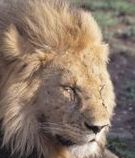 I felt fairly safe in my safari vehicle in the Serengeti where this male lion lives. However, in other parts of Tanzania, humans are not so fortunate. David Blair reports in the Telegraph that the number of lion attacks since 1990 have tripled in Tanzania. Blair indicates that about 100 people fall prey to lions today. Tanzania represents the last great bastion for lions in Africa. Of the 30,000 lions in Africa, over half roam Tanzania. About 8,000 lions in Tanzania are located in national parks and while the other 7,000 follow their prey just about anywhere they can find it, including people. In some regions where wild prey is down and human population is growing, lions seem to adapt quickly and pursue human prey as readily as they give chase to wildebeest in the Serengeti. Villages in the Mkuranga district just south of Dar-es-Salaam are visited regularly by lions. Dr Craig Packer, a known lion specialist is studying the problem to both limit risks of lion attacks on people and protect the lion from extinction.
Friday, May 12, 2006
Monkey Business
 Monkeys are again receiving attention in Tanzania. Sometime last year, scientists reported that a new monkey species had been discovered in mid-eastern Tanzania. Earlier identification was established by analyzing photographs. When a dead animal was examined earlier this year, it turns out that the new monkey deserved its own genus with close genetic ties to the baboon. The new genus name is Rungwecebus kipunji. Source: The Register.
Wednesday, May 03, 2006
Over 400 Dolphins die on Zanzibar Coast
 Biologists are still looking for answers to explain the death of over 400 bottleneck dolphins off the Zanzibar coast. Most of the dolphins washed ashore on Nungwi beach, located at the northern tip of Zanzibar Island. Preliminary examinations of the stomachs of the dead animals indicate that they had not eaten for some time or had vomited severely. More tests are planned to determine if toxic "red tide" algae might have contributed to their demise.
Tuesday, May 02, 2006
A Picture is Worth a Thousand Words
 In the spirit that pictures tell the story, I am providing a link to the BBC page "Africa in Pictures." The BBC encourages readers to send pictures and stories about Africa and other continents. The reader can browse the pictures and stories by category or by the week. Enjoy the views.
Tuesday, April 25, 2006
The Importance of Documents
 Yesterday's edition of the Business in Africa Online reported that a group of Zanzibaris filed a lawsuit with the Zanzibar High Court. The suit calls into question the legitimacy of the four-decade old agreement between the Indian Ocean Archipelago and mainland Tanzania. Prior to confederation, the mainland was called Tanganyika. The secession movement gained momentum in December when the government was unable to produce the original charter signed April 26, 1964. Unless the document can be produced and seen, Rashid Salum Addiy, spokesman for the plaintiffs, says the legitimacy of the agreement is in question. There is no word yet on when the case would be heard.
Wednesday, April 19, 2006
Darwin's Nightmare
 In this morning's issue of Scripps Howard News Service, there is a review of the Oscar-nominated documentary Darwin's Nightmare by Hubert Sauper. The setting is Lake Victoria and the protagonist is the Nile perch, which was introduced in the 1960's with deleterious effects to the lake's ecology. The documentary receives three out of four stars. Its message is not uplifting. Nevertheless, it does reinforce the reality that "Third World squalor offsets Western splendor".
Tuesday, April 04, 2006
Oldonyo Lengai Erupts
 The only active volcano in Tanzania, Oldonyo Lengai erupted earlier this week. No injuries or deaths were reported. The mountain is sacred to the Maasai, who call it the "Mountain of God." It last erupted in 1983. It is believed that ash from earlier eruptions created the "shifting sands" located west of the mountain.
Monday, April 03, 2006
Environmental News from Tanzania
 Tanzania's Vice President Dr. Ali Mohamed Shein has ordered a halt to some of the more deteriorating assaults on Tanzania's environment. Dr. Shein is concerned primarily with "reckless tree felling, use of plastic bags, uncontrolled grazing and invasion of reserved forest and mountain areas." His implementation plan is sketchy. Nevertheless, he did indicate that pastoralists should vacate reserved lands immediately. In addition, he said that "the manufacturing, importing, buying and use of plastic bags of 30 and 65 microns in thickness is now prohibited." Dr. Shein also expects "small-scale" miners to vacate reserved areas in three months. Source: Tanzania goes green -- news24.com.
Saturday, January 07, 2006
Follow Your Roots
 Get your Genographic kit and find out how you ended up where you are today. The Genographic Project, through DNA studies, can trace our ancestral migratory routes. In the end or in the beginning, the project is showing that the gene pool ground zero is in East Africa. As a result, your safari to Tanzania or other countries in the region is actually a return trip to our ancestral home. I will share the results of my particular ancestral route when I receive them. When rafiki Alex from Tanzania calls me Ndugu, it carries a much deeper significance for me. The word Ndugu in Kiswahili means brother/sisterhood.
Wednesday, December 07, 2005
News about Tanzania from allAfrica.com
 I added to the left sidebar a link for news stories about Tanzania aggregated from the site allAfrica.com. The link is located below the link for the Arusha Times. AllAfrica aggregates and indexes content from over 125 African news organizations, plus more than 200 other sources, which are responsible for their own reporting and views. Articles and commentaries that identify allAfrica.com as the publisher are produced or commissioned by AllAfrica.
Tuesday, November 15, 2005
Ndugu Habari Zenu in Chronological Order
For those who prefer to read blogs from first entry to last, I'm providing here posted entries for Ndugu Habari Zenu in chronological order.
- Back from Tanzania
- Trip Summary
- Trip Preparations
- Siku ya kwanza, Siku ya pili (Day 1-2): En Route to Tanzania
- Siku ya tatu (Day 3): Sinya Bound
- Siku ya nne (Day 4): Visit to Leyo's Village
- Siku ya tano (Day 5): Last Day in Sinya
- Siku ya sita (Day 6): Arusha National Park
- Siku ya saba (Day 7): Maasai Steppe -- Wildlife among Baobabs and Grasslands
- Siku ya nane (Day 8): Tarangire Shows its True Beauty
- Siku ya tisa (Day 9): Lake Manyara to Ngorongoro Farm House
- Siku ya kumi (Day 10): Ngorongoro Conservation Area
- Siku ya kumi na moja (Day 11): Into the Serengeti
- Siku ya kumi na mbili (Day 12): First Full Day in the Serengeti
- Siku ya kumi na tatu (Day 13): Balloon Flight, Lion Cubs, Cheetahs
- Siku ya kumi na nne (Day 14): Miti Mitatu
- Siku ya kumi na tano (Day 15): Shikwa na msiba mkuu
- Siku ya kumi na sita, Siku ya kumi na saba (Days 16-17): Mungu Ibariki Afrika
Saturday, June 04, 2005
Maasai Steppe Surveyed
The African Wildlife Foundation (AWF) is reporting that a recent aerial survey over the Maasai Steppe Heartland that includes Tarangire National Park, Lake Manyara National Park, and the Lolkisale Game Controlled Area is indicating an increase in the area's elephants. The News in Brief entry from AWF's Spring 2005 issue of African Wildlife News titled, "Counting Wildlife in the Maasai Steppe", goes on to say that, "Dozens of other species -- including buffalo, eland, Grant's gazelle, giraffe, ostrich, warthog, wildebeest, and zebra -- were also counted in the survey. Using two aircraft and a technique known as Systematic Reconnaissance Flight, the animals were first photographed and counted from the air. By carefully interpreting the photos, the aerial counts were then adjusted to estimate total population. The survey was coordinated by the Tanzania Wildlife Research Institute and co-sponsored by AWF and other partners."
Monday, May 02, 2005
More Books on Africa
I am listing more books that might help better understand the forces that shape African politics, social interaction, and economics.
African Silences, by Peter Matthiessen (natural history, non-fiction)
The Africans, by David Lamb (sub-Saharan history, non-fiction)
Cry, the Beloved Country, by Alan Paton (fiction)
Don't Let Go to the Dogs Tonight: An African Childhood, by Alexandra Fuller (personal narratives, set in Zimbabwe, non-fiction)
The Graves Are Not Yet Full: Race, Tribe, and Power in the Heart of Africa, by Bill Berkeley (a reporter's view of despotism in Africa, non-fiction)
King Leopold's Ghost, by Adam Hochschild (a story of greed, terror and heroism in colonial Congo, non-fiction)
Long Walk to Freedom (autobiography of Nelson Mandela, non fiction)
No Future Without Forgiveness, by Desmond Tutu (process of reconciliation in South Africa, non-fiction)
Scramble for Africa, by Thomas Pakenham (colonialism in Africa, non-fiction)
Scribbling the Cat: Travels With an African Solder, by Alexandra Fuller (personal narratives, set in Zimbabwe and Zambia, non-fiction)
Tales from a Troubled Land, by Alan Paton (fiction)
Too Late the Phalarope, by Alan Paton (fiction)
The Zanzibar Chest, by Aidan Hartley (sub-Saharan history and colonialism, non fiction)
African Silences, by Peter Matthiessen (natural history, non-fiction)
The Africans, by David Lamb (sub-Saharan history, non-fiction)
Cry, the Beloved Country, by Alan Paton (fiction)
Don't Let Go to the Dogs Tonight: An African Childhood, by Alexandra Fuller (personal narratives, set in Zimbabwe, non-fiction)
The Graves Are Not Yet Full: Race, Tribe, and Power in the Heart of Africa, by Bill Berkeley (a reporter's view of despotism in Africa, non-fiction)
King Leopold's Ghost, by Adam Hochschild (a story of greed, terror and heroism in colonial Congo, non-fiction)
Long Walk to Freedom (autobiography of Nelson Mandela, non fiction)
No Future Without Forgiveness, by Desmond Tutu (process of reconciliation in South Africa, non-fiction)
Scramble for Africa, by Thomas Pakenham (colonialism in Africa, non-fiction)
Scribbling the Cat: Travels With an African Solder, by Alexandra Fuller (personal narratives, set in Zimbabwe and Zambia, non-fiction)
Tales from a Troubled Land, by Alan Paton (fiction)
Too Late the Phalarope, by Alan Paton (fiction)
The Zanzibar Chest, by Aidan Hartley (sub-Saharan history and colonialism, non fiction)
Subscribe to:
Posts (Atom)